What Is HOCl? The Science and Applications of Hypochlorous Acid in Modern Medicine
Have you ever wondered if there is an antiseptic powerful enough to eliminate 99.9% of pathogens in seconds, yet gentle enough to be completely safe for baby skin, eyes, or open wounds? The answer lies within our own immune system: HOCl (Hypochlorous Acid).
HOCl is an endogenous molecule that combines rapid, broad-spectrum microbicidal action with complete human tissue biocompatibility. This comprehensive guide explores the biochemistry, medical evolution, mechanism of action, and clinical applications of HOCl.
1. What Is HOCl? The Human Body’s Endogenous Shield
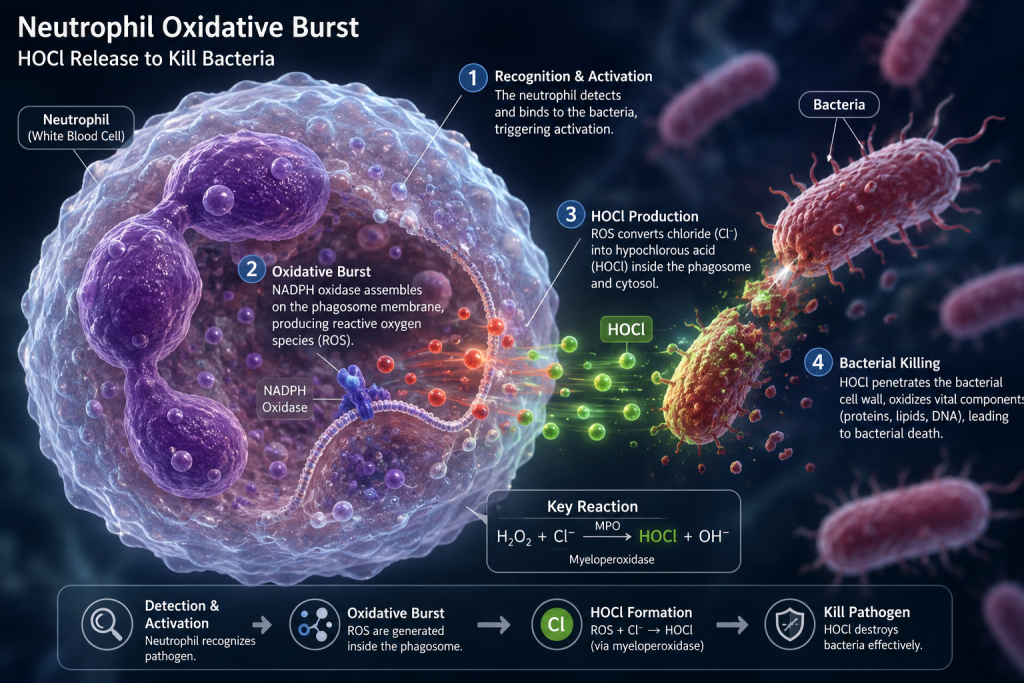
HOCl is a weak, inorganic acid that serves as a cornerstone of the human innate immune system. Rather than being a synthetic chemical foreign to human biology, it is synthesized naturally within activated neutrophils (a primary class of white blood cells).
The Natural HOCl Biosynthesis Pathway:
- Pathogen Invasion: Viable micro-organisms (bacteria, viruses, or fungi) enter body tissue.
- Neutrophil Activation: White blood cells detect foreign pathogens and migrate to the infection site.
- Oxidative Burst: Neutrophils rapidly consume oxygen to generate hydrogen peroxide
- Enzymatic Catalysis: The enzyme Myeloperoxidase (MPO) combines with chloride ions present in biological fluids.
- HOCl Release: Pure Hypochlorous Acid (HOCl) is produced to neutralize the invading threat instantly.
Despite containing “acid” in its name, pure HOCl maintained at a neutral pH (5.0–6.5) does not cause chemical burns, stinging, or tissue irritation. It functions as nature’s precise, bio-compatible defense mechanism.
2. The Historical Evolution of HOCl in Clinical Practice
The medical deployment of hypochlorous acid is not a modern discovery, but its stabilization represents a major technological breakthrough in electrochemical engineering.
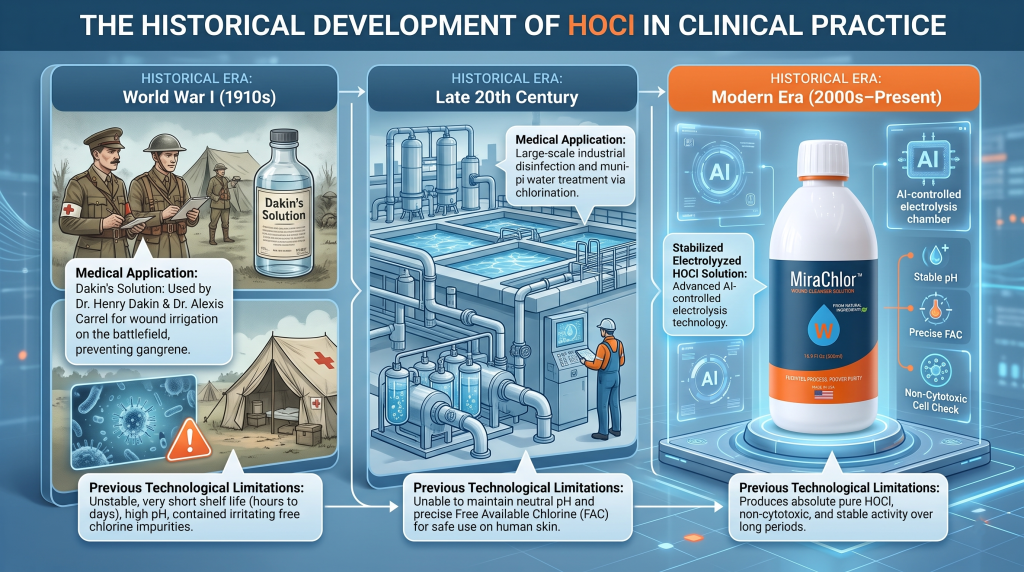
| Historical Era | Medical Application | Technological Limitations |
| World War I (1910s) | Dakin’s Solution: Used by Dr. Henry Dakin and Dr. Alexis Carrel to irrigate severe traumatic wounds and prevent gangrene in battlefield surgery. | Unstable, short shelf-life (hours/days), high pH, contained toxic free chlorine impurities causing skin irritation. |
| Late 20th Century | Industrial sanitation and municipal water treatment via bulk chlorination. | Inability to maintain neutral pH and precise active free chlorine (FAC) concentrations for topical human care. |
| Modern Era (2000s–Present) | Electrolyzed Stable HOCl: Advanced single-chamber and dual-chamber membrane electrolysis. | Produces highly stable, pH-neutral, non-cytotoxic HOCl with extended shelf-life for medical, clinical, and home use. |
Historically, the clinical utility of HOCl was constrained by its instability; the molecule rapidly oxidized and reverted to saltwater when exposed to air, light, or organic matter. Modern electrochemical technology solves this issue by manufacturing electrolyzed HOCl solutions with controlled pH and concentration, rendering it accessible for widespread healthcare and consumer use.
3. Mechanism of Action: Why HOCl Outperforms Conventional Antiseptics
The physiological superiority of HOCl over traditional disinfectants resides in its chemical structure, electrical charge, and reaction kinetics.
Key Steps in Pathogen Neutralization:
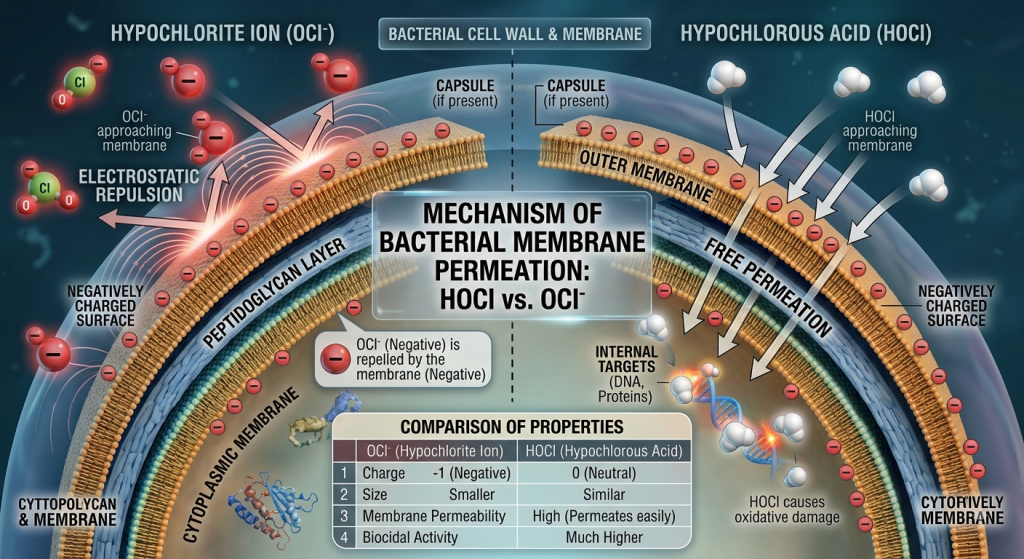
- Step 1: Charge Neutrality (Zero Electrical Resistance)
- Bacterial Cell Wall = Negative Charge (-)
- HOCl Molecule = Neutral Charge (0)
- Result: Unlike negatively charged hypochlorite, HOCl experiences zero electrostatic repulsion, allowing instant contact with the bacterial wall.
- Step 2: Rapid Intracellular Penetration
- Due to its small molecular weight and neutral charge, HOCl penetrates lipid membranes and cell walls of pathogens within seconds.
- Step 3: Multi-Target Oxidation
- Oxidizes Sulfhydryl Groups: Disables essential metabolic enzymes.
- Disrupts DNA & RNA: Stops microbial cell replication immediately.
- Inhibits ATP Synthesis: Deprives the pathogen of metabolic energy.
Peer-reviewed literature published in journals indexed by the National Center for Biotechnology Information (NCBI/PubMed) confirms that HOCl exhibits a 99.999% reduction (5-log reduction) against pathogens such as Staphylococcus aureus, Pseudomonas aeruginosa, Escherichia coli, and human coronaviruses within contact times as brief as 15 to 30 seconds.
Selective Cytotoxicity: Why Human Cells Are Safe
A common question in dermatological research is: If HOCl destroys microbial cells, why does it not damage human skin?
The answer lies in human cellular biology:
- Endogenous Antioxidant Enzymes: Mammalian host cells produce protective antioxidant enzymes—such as catalase and superoxide dismutase—which readily neutralize physiological concentrations of HOCl upon contact.
- Cellular Scale: Microbial cells are significantly smaller and structurally simpler than human eukaryotic cells, making them exponentially more vulnerable to rapid oxidative lysis.
As a result, pure HOCl is completely non-cytotoxic to human keratinocytes and fibroblasts at therapeutic concentrations.
4. Multi-Specialty Clinical and Everyday Applications
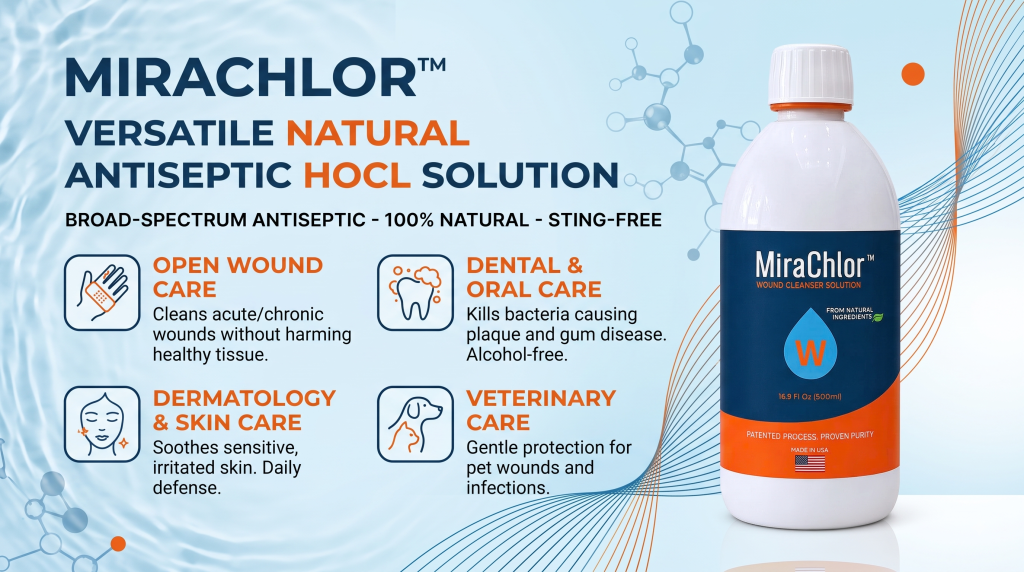
Because HOCl is both highly antimicrobial and safe for mucosal contact, its clinical utility spans diverse branches of medicine and daily personal care:
- 1. Advanced Wound Management & Ulcer Care: Disrupts bacterial biofilms, reduces microbial bio-burden without causing pain, and accelerates granulation tissue formation in chronic ulcers and surgical wounds.
- 2. Dermatology & Skin Barrier Care: Treats Cutibacterium acnes without drying skin, calms itching/redness in eczema and rosacea, and speeds recovery post-laser or chemical peel treatments.
- 3. Ophthalmology & Oral Healthcare: Functions as a non-stinging eyelid cleanser for blepharitis and acts as a safe, non-toxic oral rinse for periodontitis, gum inflammation, and halitosis.
- 4. Environmental Biodecontamination: Approved by US EPA/CDC as a high-level misting/spray disinfectant for purifying indoor air, sterilizing medical clinics, and sanitizing nursery environments without toxic residues.
- 5. Veterinary Care & Food Safety: Safely treats hot spots and wounds in dogs/cats, and serves as an eco-friendly rinse for fresh produce and processing equipment.
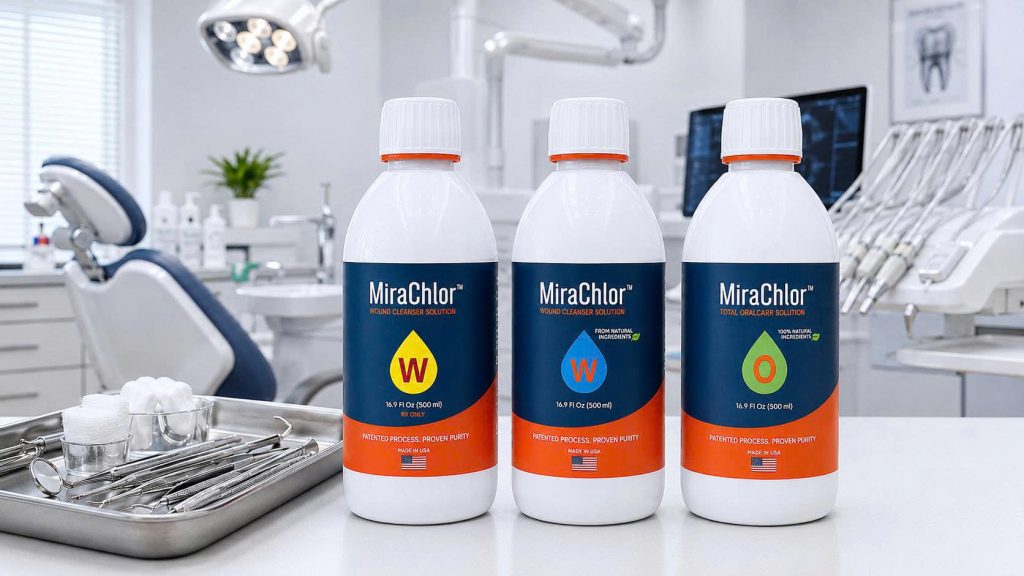
5. MiraChlor HOCl – Precision Electrolyzed Solution for Home and Clinical Use
While the biological efficacy of HOCl is unquestioned, achieving commercial stability requires advanced manufacturing processes. Raw HOCl produced by basic home devices often degrades within days into ineffective salt water or shifts toward caustic chlorine gas if pH levels fluctuate.
MiraChlor HOCl overcomes these stability hurdles using advanced electrochemical synthesis:
- Strict pH Control: Maintained within the optimal biological window (pH 5.0 to 6.5), maximizing pure HOCl presence over hypochlorite ions.
- High Chemical Stability: Formulated to maintain active free chlorine (FAC) potency over an extended shelf life.
- Medical-Grade Purity: Free from harsh additives, fragrances, alcohol, or parabens—making it gentle for pediatric, adult, and geriatric care alike.
Whether utilized for daily skin soothing, chronic wound cleansing, or safe household sanitization, MiraChlor HOCl delivers medical-grade antimicrobial protection backed by natural biology.
*“These claims has not been evaluated by the Food and Drug Administration. This product is not intended to diagnose, treat, cure, or prevent any disease.”