For licensed dental professionals — bulk orders, NET-30 available.
503.477.3661 | [email protected]
FDA 510(k) cleared · For licensed dental professionals

Close the 10–22 week gap in your post-surgical protocol.

CHX retires at 2 weeks. Osseointegration takes 3–6 months. MiraChlor™ is the only post-surgical rinse safe across the full healing window — targeting Red Complex pathogens and LPS endotoxin while preserving fibroblasts, commensals, and intracellular glutathione.
FDA 510(k) cleared
100 ppm · pH 4.5–5.5
Safe across 3–6 mo osseointegration
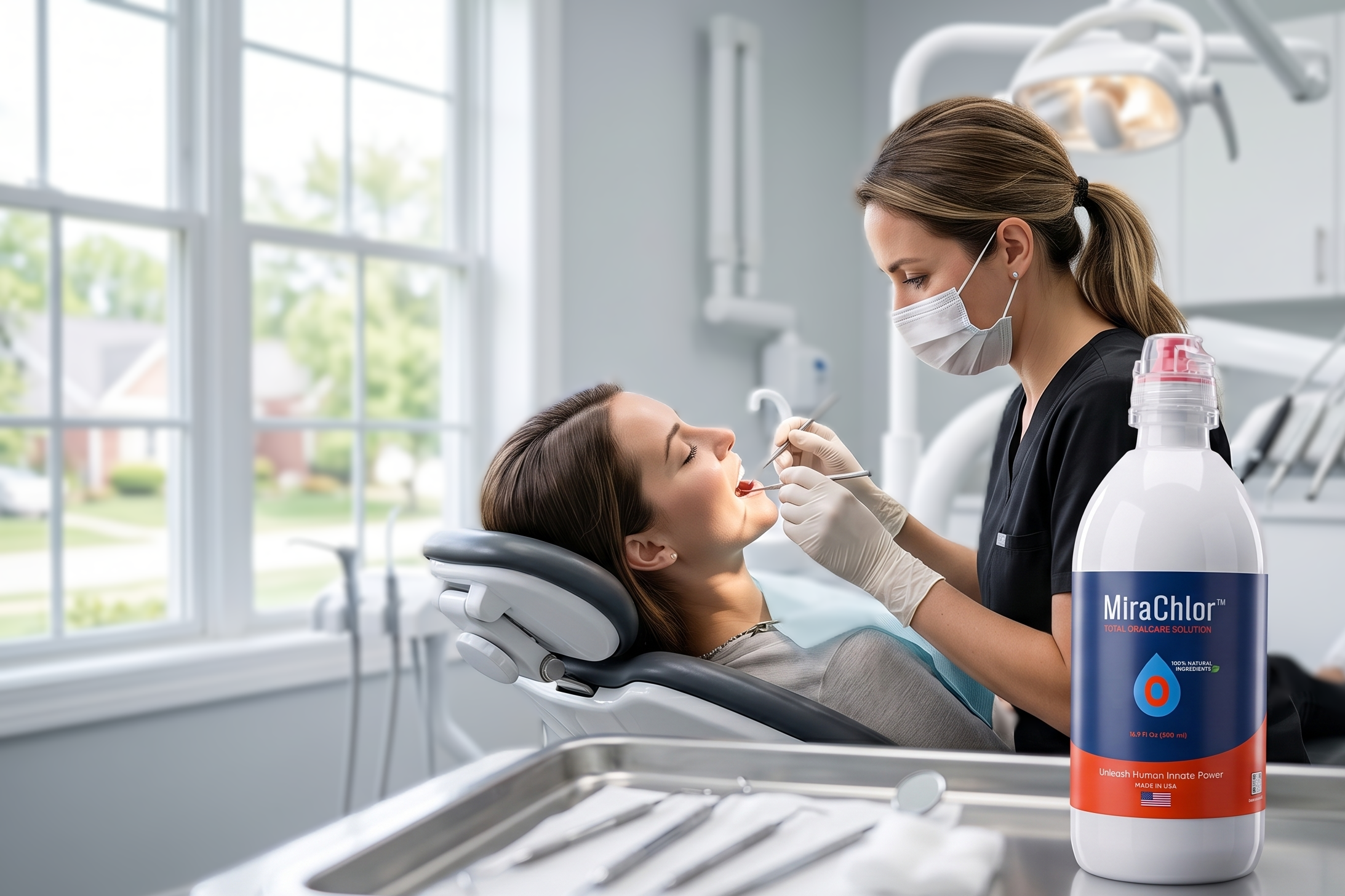
Dentist using MiraChlor chair-side during an implant procedure
RX 510(k) cleared
Chair-side strength. Pre-procedure rinse, surgical site irrigation, sub-gingival delivery — the full operatory protocol.
01. The Red Complex & biofilm

The three pathogens driving peri-implantitis — and how HOCl fights back.

Socransky's Red Complex describes the bacterial consortium most strongly associated with severe periodontitis and peri-implantitis. They organize behind biofilm, release endotoxins, and signal continued bone loss long after antibiotic intervention.

Pathogen 01
Porphyromonas gingivalis

Disables the host immune response. Key driver of alveolar bone loss in peri-implantitis.

Pathogen 02
Tannerella forsythia

Degrades structural tissue proteins. Promotes deep pocket formation and tissue destruction.

Pathogen 03
Treponema denticola

Highly motile spirochete. Penetrates biofilm matrix and disrupts surrounding tissue.

Source: Socransky SS, et al. Microbial complexes in subgingival plaque. J Clin Periodontol, 1998.

How HOCl defeats the Red Complex

Four mechanisms. One molecule. Broadly biocidal, selectively safe.

Rapid pathogen kill

Kills all three Red Complex bacteria within seconds of contact through oxidative disruption of cell membranes.

LPS neutralization

Oxidizes and deactivates LPS endotoxin released by gram-negative bacteria — stopping the bone-destruction signal that continues even after bacteria are dead.

Hawkins & Davies, Free Radical Biol Med, 2002
Biofilm disruption

Disrupts quorum sensing — the bacterial communication that organizes biofilm into drug-resistant colonies. Penetrates matrix more effectively than CHX.

Selkon et al., J Wound Care, 2006
Preserves commensals

Unlike CHX, HOCl's selectivity spares beneficial commensal bacteria, protecting the healthy oral microbiome required for proper healing.

02. Cytotoxicity — why duration matters

How current rinses affect your healing cells — and why MiraChlor is different.

The same molecule that kills bacteria can also damage the fibroblasts trying to rebuild bone and connective tissue. The right question isn't "how strong is it?" — it's "how long can you safely use it?"

Chlorhexidine (CHX)
High toxicity
  • Cytotoxic to fibroblasts at clinically used concentrations.
  • Actively depletes intracellular glutathione — the cell's master antioxidant.
  • Without glutathione: mitochondrial collapse, collagen synthesis halts, fibroblast migration stops.
  • Promotes scar-type healing rather than regenerative healing.
Max clinical use 2 weeks
Foulkes, J Dent Res, 2000 · Chang et al., J Endod, 2001
CloSYS (Chlorine Dioxide)
Moderate toxicity
  • Causes cell cycle arrest at higher concentrations.
  • Does not deplete glutathione — less harmful than CHX.
  • Limited clinical evidence for post-surgical intraoral use.
  • Strongest evidence base is outside the body (equipment, waterlines).
  • FDA has no ingestion approval for internal surgical use.
Clinical evidence Limited
Theofilou et al., Int J Oral Maxillofac Surg, 2020
HOCl — MiraChlor
Minimal toxicity
  • Neutralized by intracellular glutathione — cells remain protected.
  • Supports fibroblast migration and wound closure.
  • No measurable cytotoxicity at the 100 ppm therapeutic dose.
  • Safe for the full 3–6 month osseointegration window.
  • Enables regenerative healing — not scar tissue formation.
Safe duration 3–6 months
Robson et al., Wound Repair Regen, 2014 · Patel et al., Int Wound J, 2020
03. Side-by-side

MiraChlor vs. current options — across the criteria that matter for post-surgical healing.

Independent of marketing claims. What does the chemistry tell you about Red Complex coverage, LPS neutralization, microbiome impact, and safe duration?

9criteria
Clinical comparison points
Criterion MiraChlor HOCl CHX CloSYS (ClO₂) StellaLife
Kills pathogens Excellent Excellent Good Modest
Kills Red Complex Yes Yes Partial Limited
Neutralizes LPS Yes No No No
Biofilm penetration Yes Partial Partial No
Preserves commensals Yes No Partial Yes
Glutathione-safe Yes Depletes Partial Yes
Safe use duration 3–6 months Max 2 weeks Limited No restriction
Cytotoxicity None at 100 ppm High Moderate None
Peer-reviewed evidence 100+ years Extensive Limited Homeopathic

All claims substantiated by peer-reviewed research. Full references in the next section.

04. Clinical references

Every claim, peer-reviewed.

The science behind MiraChlor isn't proprietary — it's published. Citations below cover Red Complex microbiology, HOCl mechanism, cytotoxicity studies, and CHX glutathione depletion.

01
Peri-implantitis prevalence
Berglundh T, et al. (2018). Peri-implant diseases and conditions. J Clin Periodontol, 45(Suppl 20), S286–S291.
02
Peri-implantitis outcomes
Derks J, Tomasi C. (2015). Peri-implant health and disease. A systematic review of current epidemiology. J Clin Periodontol, 42(Suppl 16), S158–S171.
03
Red Complex pathogens
Socransky SS, et al. (1998). Microbial complexes in subgingival plaque. J Clin Periodontol, 25(2), 134–144.
04
HOCl & LPS neutralization
Hawkins CL, Davies MJ. (2002). Hypochlorite-induced oxidative damage to DNA, RNA, and polynucleotides. Free Radical Biol Med, 33(1), 114–124.
05
HOCl & biofilm
Selkon JB, et al. (2006). Evaluation of hypochlorous acid washes in the treatment of chronic venous leg ulcers. J Wound Care, 15(1), 33–37.
06
HOCl wound healing
Robson MC, et al. (2014). Hypochlorous acid as a potential wound care agent. Wound Repair Regen, 22(5), 580–590.
07
HOCl cytotoxicity (100 ppm)
Patel S, et al. (2020). Hypochlorous acid: an ideal wound care agent with powerful microbicidal, antibiofilm, and wound healing potential. Int Wound J, 17(5), 1301–1315.
08
CHX cytotoxicity / glutathione
Foulkes DM. (2000). Some toxicological observations on chlorhexidine. J Periodontal Res, 22(S3), 196–208.
09
CHX cytotoxicity (fibroblasts)
Chang YC, et al. (2001). Cytotoxic effects of chlorhexidine on human pulp cell cultures. J Endod, 27(6), 368–371.
10
CloSYS / ClO₂ evidence
Theofilou P, et al. (2020). Clinical applications of chlorine dioxide in oral healthcare. Int J Oral Maxillofac Surg, 49(7), 932–940.
For licensed dental professionals

Cover the full healing window. Schedule a Lunch & Learn.

30 minutes. Lunch on us. The clinical case for HOCl in your post-surgical, peri-implant, and high-risk patient protocols.